
1 October 2026
How to Dress a Petite Frame Under 5'3"
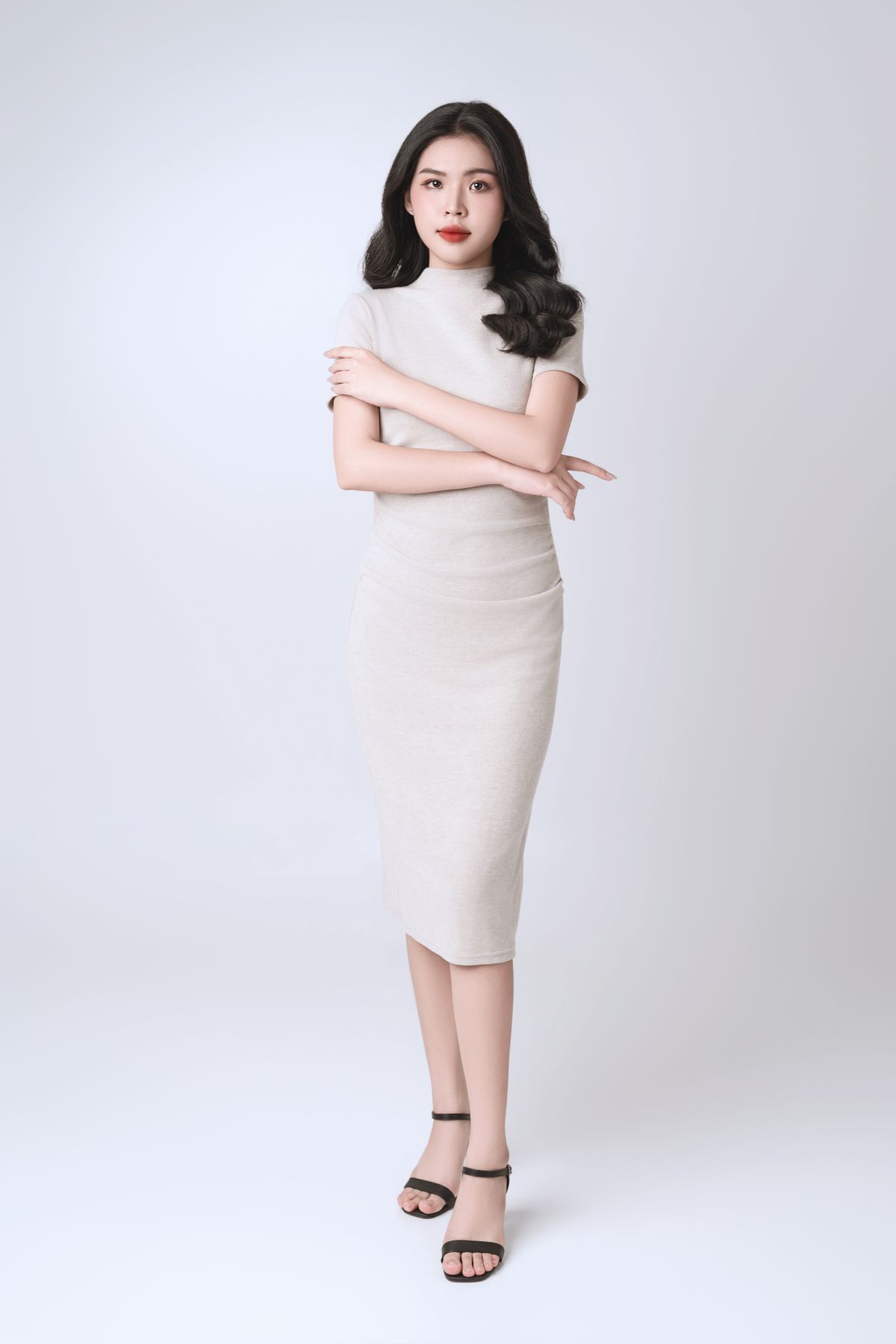
If you are under about 5'3", most clothing is cut for someone taller than you, and the result is not that it looks big — it is that the proportions land in the wrong places. The waist seam sits low, the sleeve ends past the wrist, the midi becomes a maxi. Fixing this is mostly about controlling where horizontal lines fall.
The actual problem with standard sizing
Clothing is graded from a fit model, usually around 5'7"–5'9". When a brand makes a smaller size, it reduces width far more than length. So a size S dress is narrower than a size L but barely shorter.
That is why a petite frame in a correctly sized dress still sees:
- The waist seam sitting below the natural waist
- Sleeves covering part of the hand
- A knee-length dress hitting mid-calf
- A V-neck that plunges further than intended
None of these are fit problems in the width sense. They are length problems, and most are fixable by a tailor for very little money.
Keep the horizontal lines few and high
Every horizontal line across the body — a hem, a waist seam, a belt, a colour change — divides your height into sections. The more sections, the shorter you read. The higher the main division, the longer your legs read.
Practical versions of that:
- Define the waist high. A belt or seam at or slightly above your natural waist gives you a longer lower half.
- Avoid a low-slung hip belt. It divides you near the middle and shortens both halves.
- Limit yourself to one or two strong horizontal breaks, not four.
Hemlines that work
Hems matter more for petite frames than almost anything else.
| Hem position | Effect |
|---|---|
| Just above the knee | Reliable. Shows the slimmest part of the leg. |
| Just below the knee | Works if the skirt is narrow; risky if full. |
| Mid-calf | The hardest length. Cuts the leg at its widest. |
| Ankle / full maxi | Works well, provided it genuinely clears the floor with your shoes on. |
The length to be careful with is mid-calf, because it lands at the widest part of the lower leg and leaves a short stub of ankle below. If you love a midi, have it shortened to just below the knee or lengthened to the ankle.
Monochrome is not a myth
A single colour top to bottom removes the horizontal break at the waist entirely, and the eye travels the whole length uninterrupted. It is the oldest trick in petite dressing and it still works.
This is where co-ord sets earn their place for petite frames specifically — top and bottom in one colour and one fabric, with no contrast line across the middle.
It does not have to be black. Any single colour works, including pale ones.
Scale your details
Proportion applies to details as much as garments:
- A very large print has fewer repeats across a small frame, which makes the frame read smaller. Small and medium prints sit better.
- An oversized collar, huge ruffle or very wide sleeve takes up a large percentage of your frame.
- A large tote can look like luggage. A medium or small bag is better proportioned.
- Chunky ankle straps cut the leg. A plain court, a pointed flat or a sandal with a thin strap keeps the line going.
None of this means wearing only tiny things. One deliberate large element is a style choice. Four of them is a costume.
Footwear, without pretending
A heel adds height, obviously. But the useful part is not the height itself — it is that a shoe matching your skin tone, or close to it, extends the leg line instead of stopping it.
A pointed toe adds a little visual length. An ankle strap, a contrasting colour or a chunky platform cuts it. If you prefer flats, a pointed flat does more for the line than a round-toe ballet pump.
Our footwear listings include heel heights so you can judge before buying.
Get things altered
The single highest-value habit for a petite frame is using a tailor. Shortening a hem, shortening sleeves, raising a waist seam and taking up shoulder straps are all cheap, quick alterations. A dress that fits your length looks custom-made, and nobody can tell it was altered.
Buy for the widest part of you, then have the length corrected. That is the whole strategy.
The short version
Fewer horizontal lines, placed high. One colour head to toe when you can. Details scaled to your frame. And a tailor on speed dial.
Common Questions
Yes, provided the hem genuinely clears the floor with the shoes you will wear. A maxi that drags reads as borrowed; one that ends an inch above the floor creates an unbroken vertical line and is very effective. The fix is almost always a hem alteration, which is inexpensive.